Local News
Breaking the Silence: Gandhi Jayanti and the Meat Seizure in Madurai

It was a quiet morning on October 2, Gandhi Jayanti, in Madurai. The air was filled with the scent of flowers offered in prayer, children’s laughter from temple grounds, and the soft hum of vehicles passing by. Yet, behind this peaceful scene, the city was witnessing a different story—one of law, culture, and discipline.
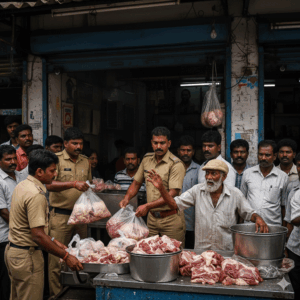
On this day, the Tamil Nadu government had ordered a full closure of meat shops across the city to honour Gandhi Jayanti, a day dedicated to peace, non-violence, and simplicity. But as the sun rose, the city corporation’s enforcement teams were already on the move, uncovering violations that painted a complicated picture of compliance.
The Discovery
By noon, officials from the Madurai City Corporation had carried out inspections in all five zones of the city. The result: 132 kilograms of meat were seized, and fines worth ₹24,500 were imposed. It was a strong reminder that rules, even those meant for a single day of respect, cannot be ignored.
The largest violation was found in Madurai North (Zone II), where 75 kilograms of meat were confiscated and shopkeepers fined ₹8,000. In other zones, inspectors found meat being sold in breach of the order: 15 kg in Zone I (East), 20 kg in Zone III (Central), and 12 kg in Zone IV (South). Zone V also reported minor violations.
“On Gandhi Jayanti, we expect full cooperation from shopkeepers and citizens,” said one sanitary inspector. “Unfortunately, some did not follow the order. That’s why these inspections were necessary.”
Enforcement in Action
The enforcement team was large and well-prepared. A total of 62 members—including sanitary inspectors, supervisors, and animators—were deployed across the city. Their task was clear: ensure that the city respected the day dedicated to Mahatma Gandhi’s ideals.
Walking alongside the inspectors that morning, it was easy to see the seriousness with which the operation was carried out. Teams moved through crowded streets, quietly checking shops, talking to owners, and noting violations. Some shopkeepers, upon seeing the inspectors, hurried to close their stores; others were caught unaware.
In Zone II, the scene was intense. Shops tucked in narrow lanes displayed piles of fresh meat behind shutters. Officials quietly entered, counted the stock, and placed the confiscated meat into large bins. The meat would later be disposed of according to hygiene regulations.
Why This Matters
For many in Madurai, Gandhi Jayanti is not just a public holiday—it is a day of reflection. Gandhi’s philosophy of non-violence extends beyond politics and into everyday life, including how people respect traditions. For some, abstaining from meat on this day is a way of honouring that philosophy.
The Madurai City Corporation’s order was a way to uphold that spirit. Yet the discovery of large quantities of meat being sold shows that awareness and enforcement must go hand in hand.
“This is about respect and lawfulness,” said the District Collector. “We understand the challenges for shopkeepers, but rules are in place to ensure harmony.”
Voices from the Market
In the bustling lanes of Madurai North, a butcher named Kumar stood watching as officials removed meat from his shop. “I forgot about the closure order,” he said softly. “Business has been slow, so I thought I could manage selling a little. But I understand it was a mistake.”
Another shopkeeper, Meena, was more apologetic. “I respect Gandhi Jayanti, but sometimes livelihood makes things complicated. I will make sure this doesn’t happen again.”
On the other side, citizens expressed mixed feelings. Rajesh, a local schoolteacher, said, “It is good they enforce the rule. Gandhi Jayanti is about peace, and following traditions matters.” But another resident, Priya, added, “People need to understand why these rules exist. Enforcement should come with awareness campaigns too.”
The Bigger Picture
This incident shows that compliance with cultural observances still needs active engagement. The city corporation, in addition to enforcing the order, used the day to remind citizens about Gandhi’s ideals through public announcements, street campaigns, and social media messages.
The meat seizure was not just a law-and-order issue; it became a moment for reflection—about respect, responsibility, and the small ways citizens can uphold values.
As the day ended in Madurai, shops closed, flowers adorned temples, and citizens moved quietly through streets softened by evening light. Gandhi Jayanti was being observed not just in ceremony, but in a conversation between tradition and modern life.
And in that conversation, the story of the 132 kg meat seized will be remembered—not just as a legal action, but as a reminder of the delicate balance between law, livelihood, and respect for shared values.




/polimer-news/media/media_files/2026/06/09/vlcsnap-2026-06-09-11h26m29s844-2026-06-09-11-33-15.png "Farmers’ Benefit vs. Social Concerns: High Court Suggests Legalising Toddy Sale")