Madurai Parking Crisis: Roadside Parking Continues Despite Two Multi-Level Car Parking (MLCP) Facilities
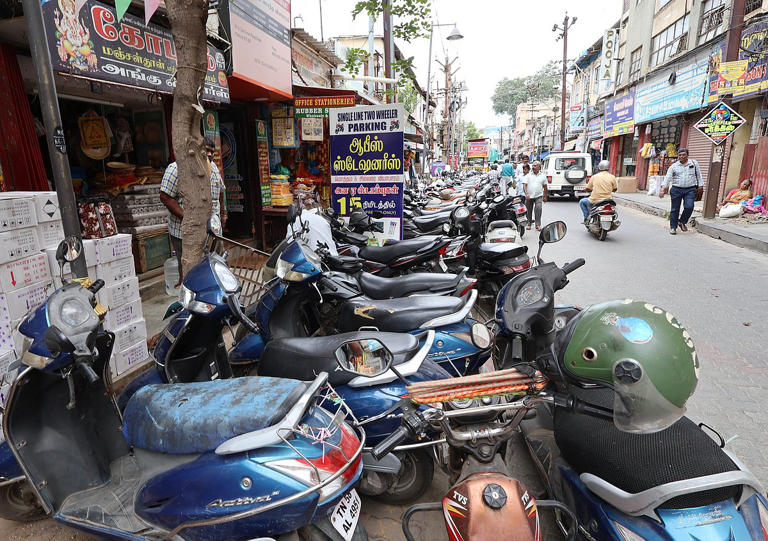
Madurai: Roadside parking continues to add to traffic congestion across several busy parts of Madurai, despite the availability of multi-level car parking (MLCP) facilities near the Meenakshi Amman Temple and at the Periyar complex.
Busy stretches including Nellupettai, Keelavasal, Periyar, Nethaji Road and the Masi streets continue to see vehicles parked along road margins. With valuable road space occupied by parked vehicles, commuters are often left with less carriageway space, contributing to traffic congestion, particularly during peak hours.
The situation has renewed calls for better parking management and greater use of the city’s existing parking infrastructure.
Roadside Parking Remains a Challenge in Central Madurai
Parking has long been a challenge in some of Madurai’s busiest commercial and heritage areas. The problem becomes more visible during peak business hours, when shoppers, employees, residents and visitors compete for limited parking space.
Vehicles parked along road margins can narrow already busy roads and make it difficult for traffic to move smoothly.
For commuters travelling through areas such as Periyar, Keelavasal and the Masi streets, the issue is not simply about finding a parking space. Roadside parking can also affect traffic flow and make movement more difficult for pedestrians and other road users.
Periyar Multi-Level Parking Facility Yet to Reach Full Capacity
The relatively new MLCP at the Periyar complex was expected to provide an alternative to roadside parking.
According to corporation officials cited in the report, the facility has capacity for approximately 226 cars and around 4,500 two-wheelers. However, its current utilisation remains considerably lower than its available capacity.
Officials said around 170 cars have been issued monthly parking passes, while approximately 90 vehicles use the facility daily.
A section of the facility also remains closed because it is located near shops within the Periyar complex that have not yet opened.
The lower utilisation has raised questions about how effectively the facility is serving its intended purpose of reducing roadside parking in the surrounding commercial area.
Meenakshi Temple Parking Facility Sees Higher Usage
The situation is different at the multi-level parking facility near the Meenakshi Amman Temple.
Corporation officials said the temple-area MLCP can accommodate around 800 cars and is being fully utilised.
The contrasting usage levels between the two facilities suggest that simply creating parking infrastructure may not be enough. Factors such as location, accessibility, pricing, convenience and awareness can influence whether motorists choose structured parking over roadside spaces.
Parking Cost and Convenience Could Influence Usage
For motorists, the decision to use a parking facility can often come down to convenience and cost.
A commuter identified in the source as M Praveen said that parking a two-wheeler at the Periyar MLCP costs approximately ₹60 per day, compared with around ₹40–₹50 at a nearby railway parking facility.
He also raised concerns about the lift at the Periyar facility reportedly not being operational, meaning some users have to walk out of the parking facility.
Such practical issues could influence the willingness of motorists to use the MLCP regularly.
However, these concerns should be assessed alongside the wider cost of roadside parking, including traffic disruption and the impact on pedestrians and other road users.
What Happened to Madurai’s Planned Regulated Parking System?
Activists have also pointed to an earlier proposal by the Madurai Corporation to introduce a regulated on-road parking system.
The proposal, reportedly planned in 2022, was intended to bring greater control over roadside parking. According to activists cited in the source, the system has yet to be implemented.
A regulated parking system could potentially help identify where on-road parking is appropriate and where parking should be prohibited because it obstructs traffic.
For a city like Madurai, such a system would need to take into account commercial streets, residential areas, heritage zones, pedestrian movement and emergency vehicle access.
What Can Madurai Do About the Parking Problem?
From a Madurai citizen’s perspective, the issue requires more than simply asking motorists not to park on roads.
A practical parking strategy could include:
- Better utilisation of existing MLCP facilities.
- Clear signboards directing motorists to nearby parking facilities.
- Transparent and competitive parking charges.
- Reliable lifts and other basic facilities.
- Monthly parking packages for employees and commercial establishments.
- Strict enforcement against dangerous or obstructive parking.
- Properly marked and regulated on-road parking wherever feasible.
- Better coordination between the Madurai Corporation and city police.
- Improved pedestrian access around commercial streets.
- Regular monitoring of parking demand in busy areas.
Commercial establishments and workers in areas surrounding Periyar could also be encouraged to use monthly parking arrangements instead of occupying road margins throughout the working day.
Parking Infrastructure Needs to Work for Citizens
The parking challenge in Madurai highlights an important point: building a parking facility is only one part of solving urban parking problems.
The facility must be convenient, affordable, accessible and easy to find. At the same time, motorists need clear information about where they can legally park.
For the city administration, the objective should be to make organised parking more attractive while ensuring that roads remain available for moving traffic.
The full utilisation of the Meenakshi Temple-area MLCP shows that motorists will use structured parking when the location and circumstances make it practical. The lower usage of the Periyar facility therefore deserves closer examination rather than simply assuming that motorists are unwilling to use multi-level parking.
A Parking Problem That Needs a Long-Term Solution
Madurai is growing as a commercial, tourism and transportation centre, and pressure on its roads is unlikely to disappear on its own.
Roadside parking may offer short-term convenience to individual motorists, but when large numbers of vehicles occupy road margins, the wider community pays through slower traffic and reduced road space.
The city now has an opportunity to make better use of its existing parking infrastructure while developing a clear and consistent parking policy.
For Madurai residents and daily commuters, the expectation is straightforward: roads should be for movement, parking facilities should be practical to use, and parking rules should be consistently enforced.
How do you experience the parking situation in Madurai? Is roadside parking affecting your daily commute? Share your experience with MaduraiCity.co.in and tell us which areas need better parking management.