Politics
Madurai’s Policy Power Plays: How State Reforms are Reshaping Madurai’s Economy

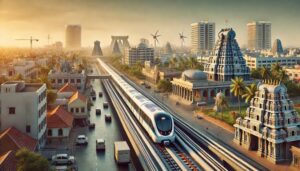

Madurai, long known for its temples, jasmine, and traditional commerce, is increasingly being shaped by state government policies that aim to modernize, diversify, and strengthen its economic base. From agriculture and MSMEs to industrial infrastructure and investment promotion, the Tamil Nadu government has rolled out multiple initiatives. The following examines how those policies are affecting Madurai—what’s working, what’s still aspirational, and what local stakeholders are saying.
Major State Policies Affecting Madurai
1. Industrial Parks and Infrastructure
The Melur Industrial Park project, approved by SIPCOT (State Industries Promotion Corporation of Tamil Nadu), is set to span 278 acres, with phase one developing 100 acres for industrial infrastructure (roads, lighting, etc.).
The state’s New Industrial Policy 2021-2025 seeks to attract massive investments (targeting over ₹10-lakh crore by 2025), raise the share of manufacturing in the state economy, and expand employment.
2. Agriculture and Value-Addition Missions
The state budget included a mission to support Madurai jasmine, moringa, and chilli cultivation—providing technical guidance, inputs like seedlings, and value-add and processing units. For jasmine especially, given its cultural significance in Madurai, this has been welcomed.
Another agricultural measure: subsidies and assistance for paddy mobile dryers to help farmers reduce loss from high moisture contents
3. Investment Promotion and Global Investor Meets
The Global Investors Meet (GIM) 2024 has led to a number of MoUs (Memorandums of Understanding). Around 77% of the MoUs signed by the state are reportedly converting into projects.
Madurai has also attracted some of these investments: about ₹1,660 crore via ~190 MoUs in district-level or regional interests.
4. Policy Support for MSMEs and Innovation
In the 2024-25 Tamil Nadu state budget, allocations for MSMEs (Micro, Small, Medium Enterprises) were significant. Trade bodies in Madurai have noted support for industrial innovation centres, free WiFi in select cities (including Madurai), and specifically a TIDEL Park in Madurai, among other things.
There is also state encouragement for aligning educational and skill training schemes to emerging sectors, especially through policies like Naan Mudhalvan, to build human capital.
Positive Impacts: What Has Changed
Job Creation and Industrial Diversification: The industrial park at Melur, non-leather footwear parks, and other infrastructural investments promise employment both directly through new factories or establishments, and indirectly via supply chains, logistics, services.
Boost to Agriculture Income & Exports: For crops like jasmine, chilli, and moringa, value-addition (such as processing units, solar dryers) along with technical support have potential to increase farmer incomes and open export markets.
Enhanced Investor Confidence: High rate of MoUs turning into real projects signals that policy frameworks, incentives, and administrative follow-through are increasingly credible, which helps attract more investment.
Improved Infrastructure: With park developments, proposed outer ring roads, river development (Vaigai river etc.), and enhancements in power, water infrastructure to support industrial parks, the physical groundwork is being laid.
Challenges, Gaps, and Local Concerns
Delay, Land & Resource Constraints: Projects like Melur Industrial Park were long-pending and delayed due to land acquisition issues, environmental clearances, and securing water and power supply.
Regional Imbalance & Inadequate Provisions: While many policy announcements are welcomed, some trade bodies in Madurai believe that budgetary allocations or infrastructure initiatives still under-serve certain localities, especially in non-urban outskirts. Some feel that projects are more focused on promise than execution.
Competitiveness of Local MSMEs: Local small producers sometimes struggle to compete with larger firms, imported goods, or with the cost burdens of modernization. Access to finance, technology, and supply chain linkages remains a concern.
Fiscal & Administrative Bottlenecks: Even when policies exist, implementation—especially at local level—can be slow. There are concerns about follow-up on maintenance, quality of infrastructure, and operationalization of declared projects. Some local stakeholders would like clearer timelines, more transparency, and accountability.
What Local Stakeholders Want & Expect
Faster implementation: reduce delay in land/clearance/resource provisioning so that declared parks, roads etc. begin operationalizing quickly.
Better support for MSMEs: especially subsidies, tax incentives, training, easier access to markets, export facilitation.
Consistent agricultural policy follow-through: ensuring value-addition infrastructure (dryers, packaging), market linkages, price supports.
Infrastructure beyond industrial: roads, power, clean water, drainage, transport connectivity that support both industry and households.
Sustainable development: balancing environmental clearances, water availability, with industrial growth. Also ensuring that traditional sectors (flower cultivation, handicrafts) are not neglected in favor of only big industries.
Conclusion
In sum, state government policies in Tamil Nadu are making a perceptible impact on Madurai’s economy. There is momentum in industrial infrastructure, agriculture value chain support, investor confidence, and MSME promotion. However, many of the benefits remain prospective or partial: the gap between policy announcements and ground realities still looms large for many. For Madurai to truly benefit from state policies, sustained implementation, local inclusion, and follow-through will be key.
Madurai’s economic future is being actively shaped by state policy—what remains to be seen is how deeply and how quickly those policy seeds translate into fruit in the lives of its people.